

I am pleased to announce the first publication from our TÜBİTAK-funded project (No: 324K166), led by Asst. Prof. Murat Uluk. While the project encompasses a broader scope of digital ethics, this initial output was shaped by the extensive effort and vision of Asst. Prof. Hande Aral Uluk, who played a pivotal role in bringing this specific study to life.
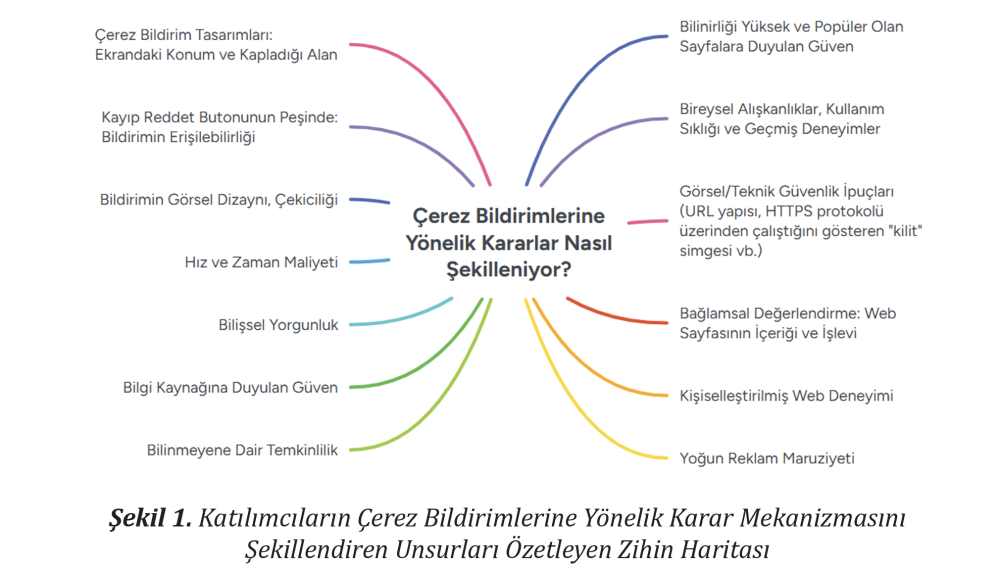
Our article, titled “‘Accept’ or ‘Reject’? A Qualitative Research on Users’ Perceptions and Decision-Making Processes Regarding Cookies,” explores the reflexes, cognitive fatigue, and trust perceptions users develop when encountering cookie notifications. The mind map shared here summarizes the complex interplay of factors influencing participant decisions.
I would also like to thank our student, Tuğçe Nur Ünlütürk, for her dedicated energy and support throughout this process.
You can find the abstract below. [Click here] to access the full article.
Cookies are small files that let websites store data on a user’s device through the browser. As data-protection rules expanded, cookie banners became nearly universal. Turkish scholarship, however, has paid limited attention to how people decide when they meet these prompts, or how “consent” is formed in everyday browsing. This study explores what users know about cookies, how they act when they see cookie notices, and what shapes their choices to accept or refuse. We conducted in-person interviews with 62 young adults aged 18–24 living in Istanbul. Most participants reported only surface-level knowledge. Despite this, they did not simply click “accept”; many approached banners with suspicion and caution. Decisions were shaped not only by digital skills but also by the mental effort of reading options, deceptive interface designs, time pressure, and trust in the website. Overall, current cookie notice practices do not support meaningful user control. We argue for clearer, non-steering consent flows that are easy to understand and grounded in design ethics.






Leave a Reply